Every chiropractor knows this scenario. You’ve just finished a complex adjustment on a patient with chronic cervical pain and thoracic dysfunction. The treatment was textbook perfect, but now comes the part that keeps you at the office long after your last patient leaves. The documentation.
SOAP notes are the backbone of chiropractic documentation. They support continuity of care, protect clinics during audits, and ensure proper billing and compliance. But for most chiropractors, SOAP notes are also one of the biggest time drains in the clinic.
Manual typing, copy-pasting templates, finishing notes after hours, and constantly worrying about accuracy, this is where AI-powered SOAP note tools are changing the game.
Let’s break down what SOAP Note AI really means, how it works, and why it represents the future of chiropractic documentation.
The Reality of SOAP Notes in Chiropractic Practices Today
Chiropractors don’t struggle with knowing what to document, they struggle with time and volume.
A typical day often looks like this:
- Back-to-back patient visits with 15-20 adjustments scheduled
- Minimal time between appointments, often just 5 minutes or less
- Notes started during the visit, finished later (or never)
- End-of-day documentation spilling into evenings or weekends
- Compliance anxiety about whether notes meet insurance and legal standards
Even with templates, SOAP notes can become:
- Repetitive and rushed, leading to copy-paste errors
- Inconsistent between providers, creating compliance vulnerabilities
- Vulnerable to missed details, especially during high-volume days
- A major cause of burnout, with doctors spending 2-3 hours on documentation after clinic hours
According to industry studies, chiropractors spend an average of 15 hours per week on documentation alone. That’s nearly two full workdays that could be spent on patient care, professional development, or simply living life outside the practice.
This is where AI for SOAP notes steps in, not to replace chiropractors, but to support how they already work.
What Is AI-Powered SOAP Note AI?
AI SOAP Note is an intelligent documentation system that uses artificial intelligence to listen, understand, and generate clinical notes in real-time during patient encounters.
Think of it as having a highly trained AI SOAP note software that:
- Understands chiropractic terminology (subluxation, diversified technique, flexion-distraction)
- Knows your documentation style and clinic workflow
- Captures every detail without you stopping to type
- Generates compliant SOAP notes formatted exactly how you need them
- Integrates with your EHR seamlessly

But here’s what makes modern AI different from simple speech-to-text or basic transcription services:
Traditional Speech-to-Text vs. AI-Powered SOAP Note AI
| Feature | Traditional Speech-to-Text | AI-Powered SOAP Note AI |
| Accuracy | 80-85% word accuracy | 95-98% clinical accuracy |
| Context Understanding | None, transcribes verbatim | Understands clinical context and intent |
| Chiropractic Terminology | Frequent errors | Trained on millions of chiropractic encounters |
| SOAP Structure | You organize manually | Auto-organizes into S-O-A-P format |
| Ambient Listening | Requires button press | Captures natural conversation |
| Post-Processing | Heavy editing required | Minimal review needed |
| Integration | Copy-paste to EHR | Direct EHR integration |
How SOAP Note AI Works in a Chiropractic Setting
Understanding the technology behind AI SOAP notes helps demystify what’s happening during your patient encounters. Here’s the step-by-step process:
Step 1: Accurate Audio Capture
The AI SOAP note software uses advanced microphones (often on a smartphone, tablet, or computer) to capture the natural conversation between you and your patient. This isn’t traditional recording, it’s ambient listening designed to filter background noise and focus on clinical dialogue.
Key Technologies:
- Noise cancellation algorithms that filter out office sounds, traffic, and equipment noise
- Speaker diarization that identifies who’s speaking (doctor vs. patient)
- Real-time processing with minimal latency (under 2 seconds)
Step 2: Speech Recognition and Transcription
Once audio is captured, the AI converts spoken words into text using automatic speech recognition (ASR) technology. Modern systems use:
- Neural network models trained on millions of hours of medical speech
- Acoustic modelling that adapts to different accents, speaking speeds, and voice characteristics
- Language models specifically trained on chiropractic terminology
Step 3: Natural Language Processing (NLP)
Here’s where the magic happens. The AI doesn’t just transcribe, it understands. Natural Language Processing analyzes the text to:
- Extract clinical entities: conditions, symptoms, anatomical locations, treatment techniques
- Identify relationships: pain radiating down left leg links pain → radiation → left lower extremity
- Recognize temporal information: 3 weeks ago, improving since last visit, acute onset
- Understand negations: no numbness vs. numbness present
- Capture patient quotes: exact language for subjective sections
Example: When you say: “Patient reports sharp pain in the lower back, radiating down the left leg to the calf, worse with sitting, improving with standing and walking. Pain started 3 weeks ago after lifting boxes at work.”
The AI extracts text to create automated SOAP note documentation, such as:
- Chief Complaint: Lower back pain with left leg radiation
- Pain Quality: Sharp
- Pain Location: Lower back → left leg → calf
Aggravating Factors: Sitting - Relieving Factors: Standing, walking
- Onset: 3 weeks ago
- Mechanism of Injury: Lifting boxes at work
Step 4: Clinical Reasoning and SOAP Structuring
Once clinically relevant information is identified, the AI organizes it into a clear and logical SOAP structure that mirrors how chiropractors already document care.
- Subjective: Captures the patient’s own words, current symptoms, pain levels, functional limitations, and any changes since the last visit. This helps establish medical necessity and continuity of care.
- Objective: Documents observable and measurable findings such as range of motion, palpation results, postural observations, and exam findings, creating a factual record of the patient’s condition.
- Assessment: Summarizes the provider’s clinical impression, progress, or response to care, connecting subjective complaints with objective findings.
- Plan: Outlines the care delivered and next steps, including adjustments performed, therapies applied, exercises assigned, and follow-up or visit frequency recommendations.
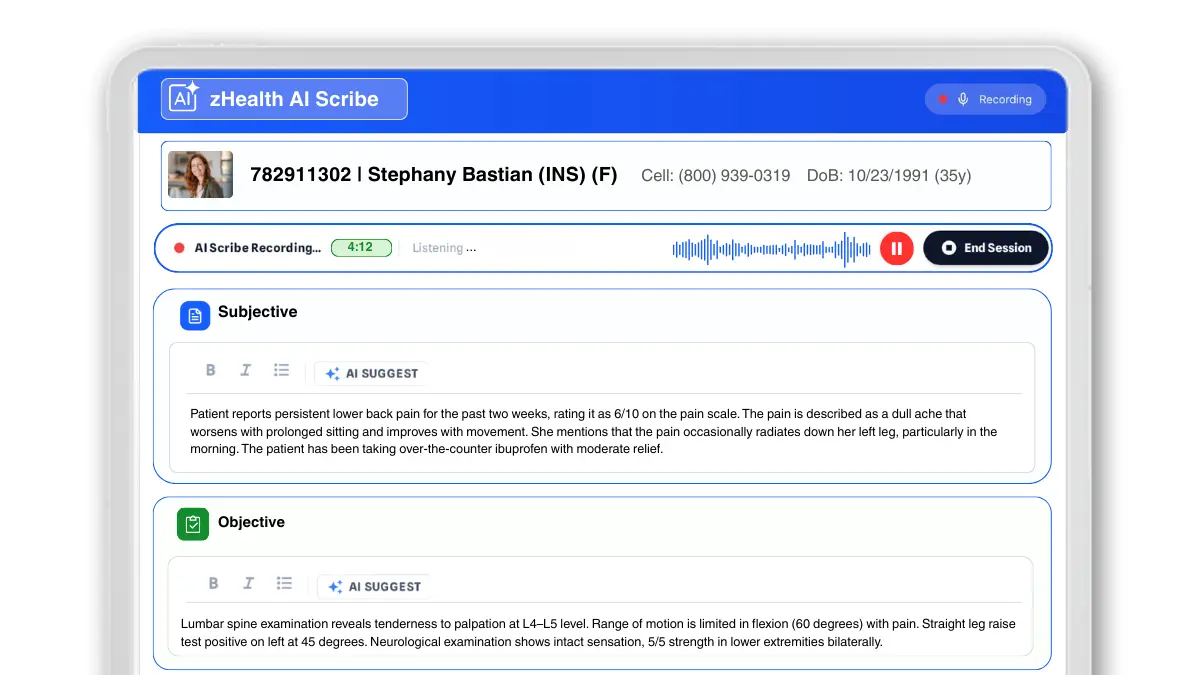
By consistently structuring information this way, AI-generated SOAP notes are easier to review, more consistent across visits, and better prepared to support compliance, billing, and audits, without adding extra work for the provider.
Step 5: Review and Finalization
Finally, the AI presents you with a nearly-complete SOAP note that requires only minimal review and sign-off. Most chiropractors spend 30-60 seconds reviewing, compared to 8-12 minutes writing notes manually.
The AI learns from your edits, continuously improving its accuracy for your specific documentation style.
Why AI-Driven SOAP Notes Are the Future of Chiropractic Documentation
- Less Time Typing, More Time Treating: By reducing manual documentation, chiropractors can focus on patient care during clinic hours, without carrying notes into evenings and weekends.
- More Accurate and Consistent Notes: AI clinical note software helps ensure that important details aren’t missed and that notes follow a consistent structure across visits and providers.
Better Support for Billing and Compliance: Clear SOAP notes that connect subjective complaints, objective findings, assessments, and treatment plans strengthen medical necessity and audit readiness. - Reduced Documentation Burnout: When documentation becomes a review process instead of a writing task, chiropractors experience less fatigue and more control over their schedules.
The Shift From Manual Notes to Intelligent Assistance
The future of chiropractic documentation isn’t about replacing chiropractors, it’s about removing unnecessary administrative work.
AI SOAP note generator represents a shift toward:
- Smarter documentation
- Better consistency
- Stronger compliance
- More time for patient care
As chiropractic practices grow busier and compliance expectations increase, AI-assisted SOAP documentation is becoming not just helpful, but essential.
Common Concerns Chiropractors Have About SOAP Note AI
1. Will AI replace my clinical judgment?
No. The chiropractor always reviews and approves the note. AI supports documentation, it doesn’t diagnose or make care decisions.
2. Is patient data secure?
Reputable SOAP Note AI tools follow strict healthcare security standards and integrate securely with EHR systems.
3. Will notes sound robotic?
Choosing the Right AI-Powered SOAP Note System
Not all AI-powered SOAP note systems are created equal. While many tools claim to automate documentation, the right automated SOAP note documentation system should support chiropractic workflows, protect patient data, and reduce daily workload.
Here are the key factors chiropractors should consider when choosing an AI-powered SOAP note system.
1. Built Specifically for Chiropractic Care: Generic AI scribes often struggle with chiropractic terminology, visit structure, and treatment styles. Look for a system designed for chiropractic practices, one that understands adjustments, common exam findings, and care plans.
2. Accurate, Structured SOAP Output: The system should do more than transcribe conversations. It must intelligently organize information into clear Subjective, Objective, Assessment, and Plan (SOAP) sections that support clinical, billing, and compliance needs.
3. Provider Control & Editability: AI should assist clinical judgment. Choose a system that allows providers to review, edit, and finalize notes before saving, ensuring accuracy and personal documentation style.
4. Easy Workflow Integration: The right AI-powered SOAP note system should fit into your existing workflow without requiring scripted speech, extra clicks, or complicated setup. The goal is to save time, not introduce new steps.
5. Security & HIPAA Compliance: Patient trust is critical. Make sure the system follows HIPAA requirements, uses encryption, and handles patient data securely at every stage.
6. Consistency Across Providers: For multi-provider practices, consistency matters. An effective AI system helps standardize documentation while still allowing individual provider customization.
7. Proven Time Savings: The best AI SOAP note tools turn documentation into a quick review process instead of a daily burden, helping providers finish notes faster and avoid after-hours work.
8. Support & Ongoing Improvement: AI systems improve over time. Choose a vendor that offers responsive support, understands chiropractic needs, and continues refining the technology based on real clinic feedback.
The Future of Chiropractic Documentation Is Assistive, Not Automated
The future isn’t about chiropractors doing less, it’s about doing less admin work so they can do more of what matters.
AI-powered SOAP Note AI represents a shift toward smarter documentation, less burnout, better compliance, and more time for patient care
For chiropractic practices looking to scale, improve efficiency, or simply reclaim their evenings, AI-driven SOAP documentation is no longer optional, it’s becoming essential.
Conclusion
AI-powered SOAP documentation is one of the most effective solutions for chiropractors. By capturing clinical conversations and organizing them into structured, accurate SOAP notes, AI helps chiropractors spend less time typing and more time treating.
But the true value of this technology comes down to how well it fits your workflow and supports your documentation needs.
That’s where zHealth AI Scribe stands apart.
zHealth AI Scribe is built specifically for chiropractic practices, with intelligent algorithms that understand your terminology, your visit structure, and your need for accuracy and control. It generates clear, structured SOAP notes that reflect real clinical care, and keeps you in command with a simple review-and-edit process before finalizing.
Here’s what makes zHealth AI Scribe the right choice for chiropractors:
- Designed for chiropractic workflows: Recognizes chiropractic-specific language and visit patterns.
- Accurate and structured documentation: Organized into Subjective, Objective, Assessment, and Plan sections that support billing, compliance, and continuity of care.
- Provider control and customization: You always review and tailor notes to fit your style and clinical judgment.
- Time back in your day: Turn documentation into a quick review instead of a chore, helping reduce after-hours work and burnout.
- Secure and HIPAA compliant: Built with healthcare-grade privacy protections so patient data stays safe.
Ready to experience better SOAP notes? Explore how zHealth AI Scribe fits into your practice and start reclaiming your time for what matters most – your patients.
Frequently Asked Questions
Q1: What are SOAP notes in chiropractic care?
A1: SOAP notes are the standard way chiropractors document every patient visit. SOAP stands for Subjective, Objective, Assessment, and Plan, and together they tell the full clinical story of the visit.
- Subjective: What the patient reports (pain level, symptoms, changes since last visit)
- Objective: What the chiropractor observes or measures (ROM findings, palpation, orthopedic tests)
- Assessment: Clinical judgment (diagnosis, segmental dysfunction, progress)
- Plan: What’s done and what’s next (adjustments, therapies, exercises, frequency)
SOAP notes aren’t just paperwork, they’re critical for clinical continuity, compliance, audits, and reimbursement. But they also take a significant amount of time, especially in busy practices.
Q2: What are AI-powered SOAP notes for chiropractors?
AI-powered SOAP notes use artificial intelligence to automatically generate chiropractic SOAP documentation during or immediately after a patient visit.
Instead of manually typing or filling templates, the AI:
- Listens to the provider–patient conversation
- Understands chiropractic terminology and workflows
- Structures the information into proper SOAP sections
For chiropractors, this means less typing, fewer late nights, and more focus on patient care, without sacrificing accuracy or compliance.
A2: Ask how long common tasks take, how documentation is handled, how billing and payments are managed, and what support is available after onboarding. It’s also important to see how easily different features work together. Connect us with our team for a quick discovery call and learn how zHealth can help grow your chiropractic business.
Q3: How does AI SOAP note software actually work during a patient visit?
A3: During a visit, AI SOAP note software works quietly in the background.
Here’s what typically happens:
- The chiropractor starts the visit and activates the AI listener
- The AI captures relevant clinical conversation and context
- It identifies symptoms, findings, assessments, and treatments
- SOAP fields are automatically populated in real time or right after the visit
- The chiropractor reviews, edits if needed, and signs off
There’s no need to change how you speak or treat patients, the AI SOAP Notes adapts to your natural workflow.
Q4: How is AI SOAP note software different from traditional speech-to-text tools?
A4: Traditional speech-to-text tools only transcribe words. AI SOAP note software understands meaning and clinical structure.
Key differences:
- Speech-to-text gives you raw text; AI creates structured SOAP notes
- Dictation tools don’t understand chiropractic context; AI is trained on real chiropractic encounters
- Dictation still requires heavy editing; AI reduces documentation time dramatically
In short, speech-to-text types are what you say. AI SOAP software understands what matters clinically.
Q5: How accurate are AI-generated SOAP notes for chiropractic visits?
A5: When the AI is trained specifically on chiropractic encounters, accuracy is very high.
Well-built chiropractic AI SOAP tools:
- Recognize common adjustment terminology (e.g., C5–C6, L4–L5)
- Understand exam findings and treatment language
- Maintain consistency across visits
That said, AI doesn’t replace clinical judgment. Chiropractors still review and approve notes, but instead of writing from scratch, they’re simply validating what’s already done.
Q6: What are the limitations of traditional SOAP note templates?
A6: Traditional SOAP note templates are static and time-consuming.
Common limitations include:
- Repetitive clicking and typing
- “Cookie-cutter” notes that lack personalization
- Easy to fall behind during busy clinic days
- Notes often completed hours or days after the visit
Templates help with structure, but they don’t reduce the mental and time burden of documentation.
Q7: Will AI SOAP notes disrupt my existing clinic workflow?
A7: No, when implemented correctly, AI SOAP notes fit into your workflow instead of changing it.
Most chiropractors find that:
- Patient flow stays the same
- Documentation happens faster
- End-of-day charting is eliminated
- Staff and providers adapt quickly
The biggest change isn’t how you work, it’s how much time you get back.
Related articles:
How Chiropractors Can Create SOAP Notes Faster With Voice Dictation
SOAP Notes, Simplified With ZHealth Software
5 Preventable And Costly SOAP Notes Mistakes (+ How To Avoid Them)