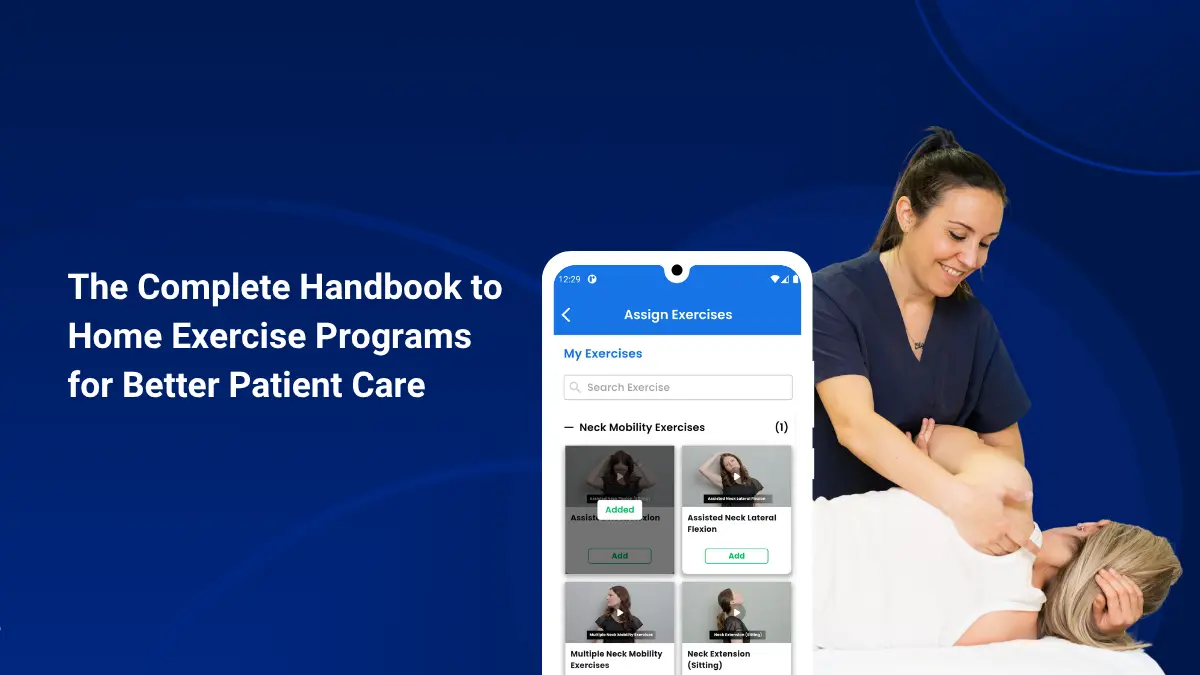
A home exercise program (HEP) is a collection of movements that a chiropractor or provider recommends for a patient to do outside the clinic. It could include a few stretches for a stiff neck, a routine to strengthen a weak core, or a mobility sequence designed to keep a healing joint from becoming stiff between visits.
The concept is straightforward, but putting it into practice is not easy. A good home exercise program for patients extends clinical care into the hours, days, and weeks when the patient is not in the treatment room. In-office adjustments and manual therapy address immediate issues. The home program supports continued progress, or when neglected, can cause it to decline.
Why Home Exercises Matter in Chiropractic Care
Chiropractic treatment works best as a partnership. An adjustment can quickly restore joint mobility or ease nerve irritation, but the muscles, ligaments, and movement patterns around that joint have taken months or years to develop. Changing those habits or creating stronger ones requires repetition, which needs to happen away from the treatment table.
This is where home exercises prove their value. They reinforce the biomechanical changes made during an adjustment, build the strength and stability needed to maintain those changes, and empower patients in their own recovery.
Research on home-based rehabilitation consistently finds that a large share of patients don’t follow through as prescribed, with non-adherence for chronic musculoskeletal conditions running as high as 50 to 70 percent. Patients who actively engage in their care between visits often report less pain, greater satisfaction, and stronger trust in the practice.
However, it’s important to acknowledge a tough reality: sticking to a program is genuinely challenging. Research on home-based rehabilitation consistently shows that many patients do not follow through as prescribed, especially for chronic musculoskeletal conditions.
Key Benefits of Home Exercise Programs for Patients
A well-structured home exercise program for patients offers benefits that extend beyond “doing homework”:
- Faster, more durable recovery: Regular exercise between sessions helps secure the progress made during in-office care, preventing it from fading.
- Reduced pain and stiffness: Focused movement keeps tissues flexible and decreases the compensatory tension that builds when someone remains inactive.
- Greater independence: Patients learn to address flare-ups and maintain their progress on their own, rather than depending solely on their next appointment.
- Improved confidence and self-efficacy: Completing a program boosts a patient’s belief in their ability to influence their outcomes, which research connects to better long-term adherence.
- Lower risk of recurrence: Strength and flexibility gained through consistent practice at home decrease the likelihood of the original issue returning.
Benefits for Chiropractic Practices
The advantages are not one-sided. Practices that recommend and support patient home exercise program usually see benefits in their own performance:
- Stronger clinical outcomes: Patients who remain engaged between visits tend to progress faster, which improves documentation and case histories.
- Higher patient retention: Ongoing engagement keeps the relationship active. Practices using structured digital tools for home rehab have reported increases in patient retention and referrals due to this additional connection (zHealth).
- Differentiation in a crowded market: Offering a clear, well-communicated home program demonstrates a level of thoroughness that paper handouts rarely achieve.
- Fewer missed opportunities for communication: Digital check-ins linked to a home program create natural moments to identify issues early, before they result in missed appointments or stalled treatment plans.
- A more efficient use of appointment time: When patients arrive having done their homework, visits can concentrate on advancing care instead of re-explaining exercises.
Most modern chiropractic AI documentation software follows a clear workflow.
Step 1: During or after a patient visit, the software captures information through structured data, provider input, or AI scribe technology. It then produces a draft SOAP note that includes subjective complaints, objective findings, assessments, and treatment & plan details.
Step 2: The provider quickly reviews the note, makes edits if necessary, and saves it directly to the patient’s chart.
Instead of taking several minutes to document each visit, chiropractors can often finish documentation in a fraction of the time.
Conditions That Benefit Most from Home Exercises for Chiropractic Patients
Not every diagnosis requires the same intensity of home program, but a few categories consistently show strong results:
Low back pain, one of the most common reasons patients seek chiropractic care, where home-based strengthening and stretching routines have demonstrated clear long-term benefits.
Neck pain and cervicogenic headaches, which are often related to posture and screen time, where mobility and postural exercises target the underlying cause directly.
Post-injury rehabilitation, including whiplash, sprains, and strains, where progressive loading at home aids healing without overstressing the tissue.
Chronic joint stiffness, such as in the shoulders, hips, or spine, where regular movement stops stiffness from getting worse between visits.
Postural dysfunction, especially common among office workers and anyone spending long hours at a desk or on a phone.
Balance and fall risk concerns, particularly relevant for older patients, where targeted stability exercises can significantly reduce fall risk over time.
A home exercise program (HEP) is a set of movements a chiropractor or provider prescribes for a patient to perform outside the clinic. It might be a handful of stretches for a stiff neck, a strengthening routine for a weak core, or a mobility sequence designed to keep a healing joint from stiffening up between visits.
The idea is simple, but the execution rarely is. A well-designed HEP extends clinical care into the hours, days, and weeks when the patient isn’t in the treatment room. In-office adjustments and manual therapy address what’s happening right now. The home program is what carries that progress forward, or, when it’s skipped, what lets it slip backward.
Types of Home Exercises to Prescribe
A comprehensive home exercise strategy typically draws from five categories, layered based on the patient’s condition, goals, and stage of recovery.
Stretching
Stretching addresses tightness in muscles and connective tissue that restrict range of motion. For chiropractic patients, this often targets the hip flexors, hamstrings, chest, and upper trapezius, areas that tend to shorten with prolonged sitting or poor posture. Gentle, sustained stretches are usually more appropriate for home settings than aggressive or ballistic ones.
Strengthening
Strengthening exercises build the muscular support needed to hold spinal and joint alignment in place. Core stabilization work, glute activation, and scapular strengthening are common starting points, since weakness in these areas is closely tied to many of the complaints chiropractors treat.
Mobility
Mobility exercises restore fluid movement through a joint’s full range, which is distinct from flexibility work. Controlled articular rotations, cat-cow variations, and thoracic rotations are frequently prescribed to keep the spine and major joints moving well between visits.
Balance & Stability
Balance training is especially valuable for older patients or anyone recovering from an injury that’s affected proprioception. Single-leg stands, controlled weight shifts, and stability-ball work help retrain the body’s sense of position and reduce fall risk over time.
Postural Correction
Postural exercises retrain the habits that contribute to chronic strain, forward head posture, rounded shoulders, and anterior pelvic tilt among them. Chin tucks, wall angels, and pelvic tilts are simple enough for almost any patient to perform correctly at home, which makes them a reliable starting point.
How to Create an Effective Home Exercise Program
The difference between a program that a patient actually follows and one that gets forgotten often comes down to a few design choices:
Start small
Three to five exercises are much more likely to be completed consistently than a list with fifteen items. Complexity is a major reason why programs get abandoned.
Match the exercises to the diagnosis and the individual. A program designed for a 30-year-old athlete looks very different from one made for a 70-year-old managing chronic stiffness, even if the underlying issue is similar.
Explain the “why.”
Patients who understand how a specific exercise relates to their complaint are more likely to stick with it than those who receive just a list.
Show, don’t just tell.
Visual demonstrations, whether in person, on video, or through annotated images, reduce the risk of a patient performing a movement incorrectly, which can lead to injury or no benefit.
Build in progression.
A program that never changes can become dull and eventually no longer matches the patient’s improving ability. Plan checkpoints to increase difficulty or add exercises.
Set a realistic frequency.
Clearly defined sessions, such as two or three times a week, typically perform better than vague instructions like “do these daily when you can.”
Tips to Improve Patient Compliance
Even a well-designed program can go unused if compliance isn’t actively supported. Here are a few strategies that consistently work:
1. Use video or app-based instructions instead of relying on static handouts. Patients forget verbal cues quickly, and a video they can replay helps address this issue.
2. Send reminders. Simple automated nudges, whether through text, email, or app notifications, can significantly improve patient follow-through.
3. Track progress visibly. Allowing patients to log completed sessions, even informally, builds momentum and provides them (and their provider) with a clear record of consistency.
4. Check in between visits. A brief message asking how the exercises are going shows patients that their effort is being noticed, not just assigned.
5. Celebrate small wins. Recognizing improved range of motion or reduced pain reinforces that the home exercises are effective.
6. Address barriers directly. Ask patients what obstacles they face rather than assuming the exercises alone are the problem.
Common Mistakes to Avoid
Even experienced providers can undermine their own home exercise programs with a few recurring mistakes:
- Overloading the program. More exercises rarely lead to better outcomes; they usually just lower completion rates.
- Skipping the explanation. Handing over a sheet without context leaves patients unclear about why they are doing the exercises, which lowers motivation.
- No follow-up. A program prescribed once and never revisited tends to stagnate or get abandoned altogether.
- One-size-fits-all handouts. Generic sheets taken from a template often don’t match the patient’s actual condition or ability level.
- Ignoring patient feedback. If a patient reports pain or confusion with an exercise, that’s a sign to adjust, not something to note and overlook.
- Relying entirely on paper. Handouts are easy to lose and hard to update, limiting their effectiveness compared to more accessible formats.
Digital Home Exercise Programs vs. Paper Handouts
Paper handouts have been the standard for decades, and they still have a purpose, they’re simple, need no technology, and work well for very short-term or low-complexity programs. However, their limitations become apparent quickly: they can get lost, they don’t demonstrate movement, and there’s no way to track if a patient has actually used them.
Digital home exercise programs address most of these gaps directly. Video demonstrations lower the risk of a patient doing an exercise incorrectly. Built-in reminders and progress logs give both the patient and provider insight into adherence. With home exercise program software it is easier to update exercise videos and a provider can modify a plan mid-course without needing to reprint or re-explain anything.
The shift toward digital delivery is already happening in the field. Mobile health apps that provide treatment plans, exercise instructions, and progress tracking are becoming more common in chiropractic clinics. Patient portals, now used by about three in five patients to access their own health information, are becoming the norm rather than an add-on (American Chiropractic Association). For practices considering the switch, the question is increasingly not whether to go digital, but how quickly.
Integrating Home Exercise Programs into Your Clinic Workflow
Even the best-designed chiropractic home exercise program won’t help patients if it’s added to the workflow as an afterthought. Here are a few practical steps that can make integration smoother:
Assign the program during the visit, not after. Handing over (or sending) the exercises while the patient is still in the room, with time for questions, greatly increases the likelihood they will understand and follow it.
Standardize your templates. Create a library of common exercise sets by condition so that staff aren’t building programs from scratch for every patient.
Assign clear ownership. Decide who on the team is responsible for prescribing, updating, and following up on home programs to ensure nothing falls through the cracks.
Tie it to your documentation. Recording what was prescribed and how the patient responded helps both clinical decision-making and compliance tracking.
Review adherence at every follow-up. A quick check on how the home program is going should be as routine as checking in on symptoms.
How Technology Simplifies Exercise Prescription
Technology has transformed home exercise programs by making them easier for both providers and patients. Instead of printing handouts for every visit, providers can quickly assign personalized exercise plans with videos, instructions, and recommended schedules.
For patients, a mobile app makes following their program much simpler. They can access prescribed exercises anytime, watch demonstration videos to ensure proper form, and check off completed exercises from their phone. This eliminates the guesswork that often comes with paper handouts and helps patients stay consistent with their recovery plan.
Mobile apps also improve communication between visits. Patients can receive reminders to complete their exercises, review their progress, and contact their provider if they experience pain or have questions. This ongoing connection helps improve adherence, keeps patients engaged in their treatment, and allows providers to make informed adjustments during follow-up visits.
By combining personalized exercise prescriptions with an easy-to-use patient app, clinics can improve compliance, enhance patient outcomes, and create a more connected care experience.
Conclusion
A home exercise program is only as good as the thought put into building it and the follow-through put into supporting it. The harder part, and the part that actually separates effective programs from ignored ones, is design and delivery: keeping programs simple, explaining the reasoning, demonstrating movements clearly, and staying engaged with patients as they work through it.
With zHealth’s Home Exercise Videos and Mobile Apps, providers can assign personalized exercise plans from an extensive video library, send them directly to the patient’s mobile app, and allow patients to access step-by-step video demonstrations anytime, anywhere. Patients can stay on track with their prescribed exercises, while providers save time and deliver a more consistent care experience.
If you’re looking for a simpler way to prescribe, manage, and track home exercise programs, request a free demo to see how zHealth can help your practice improve patient engagement, boost compliance, and achieve better treatment outcomes.
Related Articles:
Group Practices: Your Blueprint for Improving Patient Experience and Retention
5 Proven Ideas for Keeping Patients Engaged Between Appointments
Chiropractic Patient Engagement Tools: Why They Work and Why You Need Them