If you’ve ever seen a front desk team spend half their morning on hold with insurance companies, only to learn that a patient’s coverage lapsed three weeks ago, you understand the challenge. Patient insurance eligibility verification seems simple on paper, but it quietly drains time, money, and efforts from wellness practices every day.
The good news is that modern EHR software has changed the situation. It not only digitizes a manual process but also rethinks how eligibility verification works and when it occurs.
Why Manual Insurance Eligibility Verification Is Challenging
Insurance eligibility verification is a critical step in the revenue cycle, but it is also one of the most time-consuming tasks. Many practices still depend on phone calls, payer websites, spreadsheets, and manual processes to check patient coverage before appointments.
The cost of making mistakes here isn’t just administrative. 41% of providers say their claims are denied over 10% of the time, according to the State of Claims Report 2025 from Experian. Even a single denied claim can cost a practice between $25 and $117 to fix and resubmit. Multiply that across hundreds of patients a month, and you have a serious revenue problem.
Although it seems like a routine task, manual verification can create bottlenecks, increase administrative workload, and lead to costly mistakes that impact both the practice and the patient experience.
1. Time-Consuming Process: For many front desk teams, insurance verification begins long before a patient arrives. Staff members often have to contact insurance companies, search through payer portals, and gather information from various sources just to confirm a patient’s benefits.
2. Human Errors: Even highly experienced staff can make mistakes when insurance verification is done manually. A single typo, overlooked coverage limitation, or outdated policy detail can create issues that may not be discovered until after services have been provided.
3. Increased Administrative Burden: Front desk teams already have a lot on their plates. Between scheduling appointments, checking patients in, answering phones, collecting payments, and handling paperwork, little room is left for another time-consuming responsibility.
4. Last-Minute Eligibility Issues: One of the biggest frustrations for both patients and staff is discovering an insurance issue after the patient arrives for their appointment. Perhaps the patient’s coverage has lapsed. Maybe their deductible has changed, or an authorization is missing. Whatever the situation, these surprises can lead to uncomfortable conversations and unnecessary delays.
The 3 Phases of the Patient Journey
Before looking at individual touchpoints, it’s helpful to understand the complete picture. Every touchpoint falls into one of three phases:
Phase 1: Pre-Service
Everything that happens before the patient arrives, such as clinic discovery, appointment scheduling, reminders, and intake forms.
Phase 2: In-Service
The live clinical experience, such as check-in, waiting room, consultation, treatment, payment, and checkout.
Phase 3: Post-Service
Everything that occurs after they leave, such as follow-up communication, billing statement, review requests, in-home exercise recommendation, patient education, and recall messaging.
Most clinics focus almost entirely on Phase 2 and overlook the 60% of the journey that occurs before and after. This is where patients are lost, and where the greatest potential for retention exists.
The Cost of Poor Eligibility Verification
Insurance eligibility verification may occur behind the scenes, but its impact is felt across every area of a practice. When coverage information is inaccurate or incomplete, it can harm revenue, operations, staff morale, and patient satisfaction.
- Claim Denials
One of the most common results of poor eligibility verification is claim denials. If insurance coverage is inactive, benefits have changed, or authorization requirements were missed, the payer may reject the claim entirely.
- Delayed Reimbursements
Even when claims are eventually paid, eligibility issues can significantly slow down the reimbursement process. Instead of receiving payment promptly, practices may spend weeks resolving coverage discrepancies and communicating with payers.
- Increased Accounts Receivable (A/R)
Unverified or incorrectly verified insurance information often results in unpaid claims lingering in accounts receivable. The longer claims remain unresolved, the harder they become to collect.
- Unexpected Patient Balances
Patients expect their insurance information to be verified before treatment. When eligibility issues are uncovered after services are provided, patients may receive unexpected bills. These situations can undermine trust and lead to difficult financial discussions.
- Patient Dissatisfaction
Patients judge their experience based on more than just clinical care. Insurance surprises, billing issues, and appointment delays can leave a negative impression, even if the provider delivered excellent treatment.
- Staff Burnout
When eligibility issues keep happening, someone has to resolve them and that responsibility typically falls on the front desk and billing team. Constantly calling payers, correcting claims, answering patient questions, and resolving coverage issues can result in staff burnout over time.
The more manual the verification process, the more likely these challenges are to happen.
What Smart EHR Actually Means Here
Not all EHR systems handle eligibility the same way. There’s a significant difference between a system that requires you to manually submit an eligibility request through an insurance payer portal and one that automatically verifies coverage in the background.
Real-Time Eligibility Checks
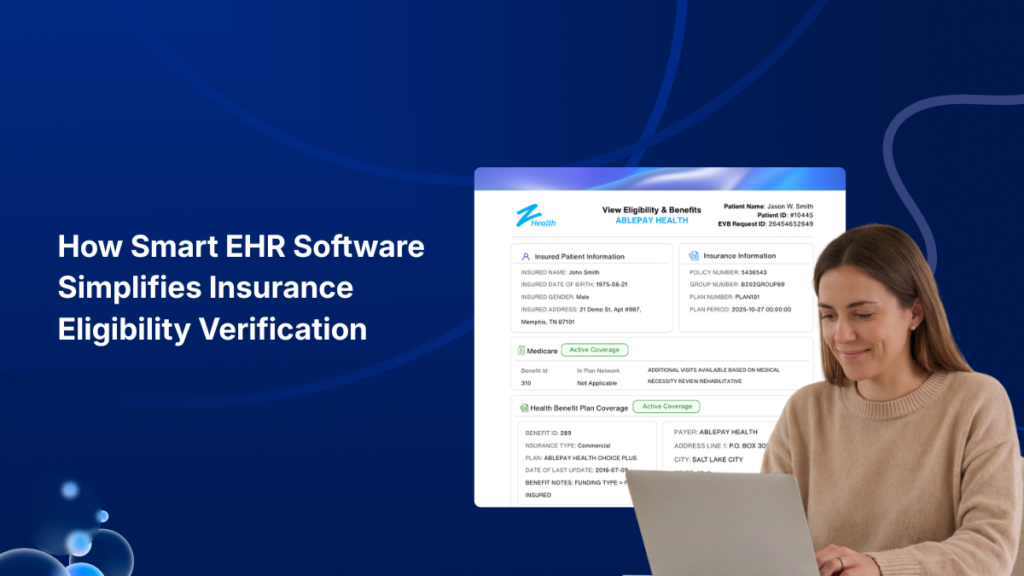
An EHR with automated patient eligibility verification connects directly to payers through clearinghouse networks and can obtain real-time eligibility data rapidly, often within seconds or minutes. When a new appointment is scheduled, you can immediately check whether the patient is covered, what their deductible looks like, and what their co-pay will be..
The Workflow Transformation, Step by Step
Here’s how the process changes when a practice shifts from manual verification to a smart EHR:
|
Before using smart EHR |
With smart practice management software |
|
|
How Smart EHR Software Simplifies Insurance Eligibility Verification
Insurance eligibility verification doesn’t have to take up a lot of time for your staff. Modern EHR software for insurance verification can automate much of the process. This helps practices verify coverage quicker, reduce errors, and enhance the overall patient experience.
Here’s how smart EHR software makes insurance eligibility verification easier.
Real-Time Eligibility Checks
One of the main benefits of modern EHR software is the ability to verify insurance coverage in real time.
Instead of calling payers or logging into multiple insurance portals, staff can check a patient’s eligibility in just seconds. This is one of the many ways EHR automation for clinics helps reduce administrative workload and improve operational efficiency. You or your staff can confirm coverage before the appointment and catch potential issues early.
With real-time eligibility verification, practices can:
- Confirm active insurance coverage instantly
- Verify deductibles, co-pays, and co-insurance amounts
- Check visit limits and coverage restrictions
- Identify authorization requirements before treatment
- Spot coverage issues before the patient arrives
Having access to accurate insurance information before the visit helps eliminate surprises and allows staff to address any concerns ahead of time.
Centralized Insurance Information
Many practices face challenges because insurance information is scattered across multiple systems, websites, emails, and spreadsheets.
The best EHR software brings all eligibility and insurance information into one place within the patient’s record. Instead of searching through multiple sources, staff can quickly access the information they need while scheduling appointments, checking patients in, or preparing claims.
Benefits of centralized insurance information include:
- Easy access to patient coverage details
- Reduced duplicate data entry
- Better visibility across the practice
- Fewer administrative errors
- Faster access to information when patients have questions
Having everything in one location helps create a smoother workflow for both front desk and billing teams.
Faster Patient Check-In
No one enjoys finding out about insurance issues at the front desk while patients are waiting.
When eligibility has already been verified through the EHR, the check-in process runs more smoothly. Staff can focus on welcoming patients instead of rushing to confirm benefits at the last minute. This helps practices:
- Reduce check-in delays
- Minimize paperwork and manual verification
- Improve patient flow throughout the day
- Create a better patient experience
- Allow staff to spend more time assisting patients
Reduced Claim Denials
Claim denials often stem from eligibility issues that could have been detected before services were provided.
When coverage, benefits, authorizations, and policy status are verified ahead of time, practices can submit cleaner claims with more confidence. This decreases the chances of denials and helps billing teams spend less time fixing and resubmitting claims. By verifying coverage before treatment, practices can:
- Prevent avoidable claim denials
- Reduce billing errors
- Improve first-pass claim acceptance rates
- Speed up reimbursement timelines
- Strengthen overall revenue cycle performance
Instead of finding problems after a claim has been submitted, practices can tackle potential issues before they affect reimbursement.
Compliance and SOAP Documentation
When a practice manually verifies eligibility by phone, the record of that verification is often someone’s handwritten note or a memory. That’s not great when a payer disputes a claim and asks when the practice confirmed coverage.
EHR systems with automated insurance eligibility verification feature can log every eligibility check with a timestamp, the response received, and the data returned. This creates an auditable trail, which matters during payer audits, compliance reviews, and claim disputes.
If a payer says coverage wasn’t active on the date of service and you have documented proof that your system confirmed it was, you’re in a much stronger position.
What to Look for When Evaluating EHR Eligibility Tools
Not every system marketed as “EHR with eligibility verification” delivers the same experience. When evaluating platforms, here are the questions worth asking:
- Clearinghouse connections: How many payers does the system connect to directly? Broad payer networks mean fewer manual exceptions. Some systems connect to 900+ payers; others leave significant gaps.
- Automation depth: Does the system automatically trigger checks at scheduling, or does staff have to initiate them? Truly automated systems require minimal human prompting.
- Integration with billing: Does verified eligibility data flow automatically into claims? Or does staff have to re-enter it?
- Specialty-specific information: Some specialties (chiropractic, physical therapy, behavioral health) have unique coverage rules, visit limits, prior authorization requirements, and so on. Does the system account for those nuances, or does it give you generic eligibility responses?
- Reporting and analytics: Can you see denial rates by payer? Identify which insurance companies have the highest eligibility-related rejection rates? That data is gold for revenue cycle management.
The Revenue Cycle Impact: Connecting the Dots
Clean eligibility data means fewer claim denials. Fewer claim denials mean less A/R aging. Less A/R aging means faster cash flow. And faster cash flow means the practice can operate with more financial stability and predictability.
The domino effect runs in both directions. Practices with poor eligibility processes tend to have elevated denial rates, stretched A/R, more staff time spent on rework, and lower net collections overall. Practices with solid eligibility processes tend to run cleaner billing cycles across the board.
The Medical Group Management Association (MGMA) has found that high-performing practices collect more than 95 cents on every dollar billed, while average performers collect closer to 80 cents. Eligibility verification is one of the foundational reasons for that gap.
Conclusion
If you’re running a chiropractic practice and you’ve read this far, you’ve probably recognized your own workflows in a few of these scenarios.
zHealth is built specifically for chiropractic practices and its EHR software comes with integrated eligibility verification. Rather than bolting generic eligibility tools onto a one-size-fits-all EHR, zHealth integrates real-time and automated eligibility verification directly into the chiropractic patient management workflow.
That means automatic eligibility checks tied to the appointment schedule, payer-specific benefit details surfaced for chiropractic services, visit limit tracking, and clean integration between verified eligibility data and the billing process. The result is fewer surprises at the front desk, fewer denials in the billing cycle, and more time for your team to focus on patient care instead of paperwork.
Insurance eligibility verification doesn’t have to be the part of running a practice that nobody wants to deal with. With the right tools, it becomes a largely invisible process that just… works. And when it works, everything downstream works better too.
Want to see how zHealth handles eligibility verification for your practice? Schedule a demo and see the difference firsthand.
Related Articles:
ICD-10 Chiropractic Codes: Avoid Claim Denials Pertaining to Excludes Notes
6 Effective Tips for Chiropractic Practices to Improve Billing and Claims Process
5 Modifiers That Are Necessary on Chiropractic Claims
A Chiropractic Clinic’s Guide to Automating Front Office